How to Test an AI Receptionist Before You Buy It (2026).
Almost every vendor has a demo number. Here is how to use it critically: five things to say so you hear whether it handles your kind of calls.
You test an AI receptionist by calling it yourself with the questions your own customers ask, talking over it once, asking something it cannot possibly know, and then asking to see the summary.
Almost every vendor has a demo number you can call freely. That is generous, but a demo number is built to impress. The question is how you use it to stay critical instead of getting swept along.
A demo call where you speak politely tells you nothing
A demo number is tuned for the expected conversation. Only when you step outside that conversation do you hear how the system behaves in your situation.
Most people call, say “I would like to book an appointment”, hear a friendly voice, and hang up feeling good. That is exactly the call it was built for.
Your customers call differently. They ask things that have to do with your work, they talk over you, and they ask questions nobody prepared an answer for. You want to know what happens then.
The five tests below take about ten minutes together. Do them with every vendor you are considering, in the same order and with the same sentences. Otherwise you are comparing behaviour you provoked at different moments.
Call with the questions your customers actually ask
Write down beforehand which five calls come in most often at your place. Call with those, not with “I would like to book an appointment”.
This is the most important preparation and the one most people skip. An AI receptionist that can book an appointment tells you nothing about what it does with the question you get every day.
Think of the ones you recognise. Do you cover my area? What does this cost roughly? Can I move my appointment? Do you even do this kind of work? How quickly can you be here?
With each answer, watch two things. Does the caller get a real answer, or only the promise of a call back? And is the answer correct, or does it merely sound good?
Afterwards, ask the vendor where that answer came from. From information they filled in, or from your own website? That difference decides how much work it is to set up for you.
Talk over it and see whether it waits
Interrupt the AI receptionist halfway through a sentence. Does it stop and listen, or does it finish its sentence and carry on where it left off?
You know the awkward moment on the phone where two people start at once, both stop, and then both start again. With a person that is a small laugh. With a system that is not built for it, the call stalls.
Do it twice. Once during the greeting, once in the middle of an answer. Some systems can only be interrupted at fixed moments.
Watch what happens to your words afterwards, too. Stopping is one thing, but did it also hear what you said while it was still talking?
Ask something it cannot possibly know
Ask a question no answer was prepared for. A good system says it does not know and makes a note. A weak system invents something.
Think of something plausible that you know is not configured. Do you work across the border? What does an emergency job cost on a Sunday? Do you carry that brand?
This is the test that tells you most. An AI that guesses on your behalf makes an appointment you then have to undo, or a promise you are stuck with. That costs you more than a missed call.
You want to hear that it does not know, that it notes the question, and that someone will call back. Then ask whether that behaviour is configurable or whether it was luck. Getting it right once is not a rule.
Ask to see the summary, because that is the whole point
Afterwards, ask for the message you would receive as the business owner. Not every vendor shows that in a demo, and that in itself is information.
A call is only successful if something usable comes out of it. What the caller heard is half of it. What you read afterwards is the other half, and that is the half you have to work with.
Go through what you get:
- Does one sentence at the top say what it was about?
- Are the details pulled out: a name, a number, a time, an address?
- Can you read the whole conversation back if you doubt the summary?
- Can you play the recording if the text does not match?
- Does it match what you said, or is exactly one thing missing?
That last one is why you want to see it. The summary tells you what the system took from your call and what it let go. A friendly conversation that produces a vague note is not a successful call.
Ask where that message arrives, too. A message in a dashboard you open once a day is a different thing from a message in WhatsApp.
Spell a surname and listen to what survives
Spell a difficult surname or a postcode. Then check the summary to see what is left of it. This is where systems stumble most often.
Take something genuinely awkward. Van der Heijden. Bruijninckx. Or a postcode with a letter suffix.
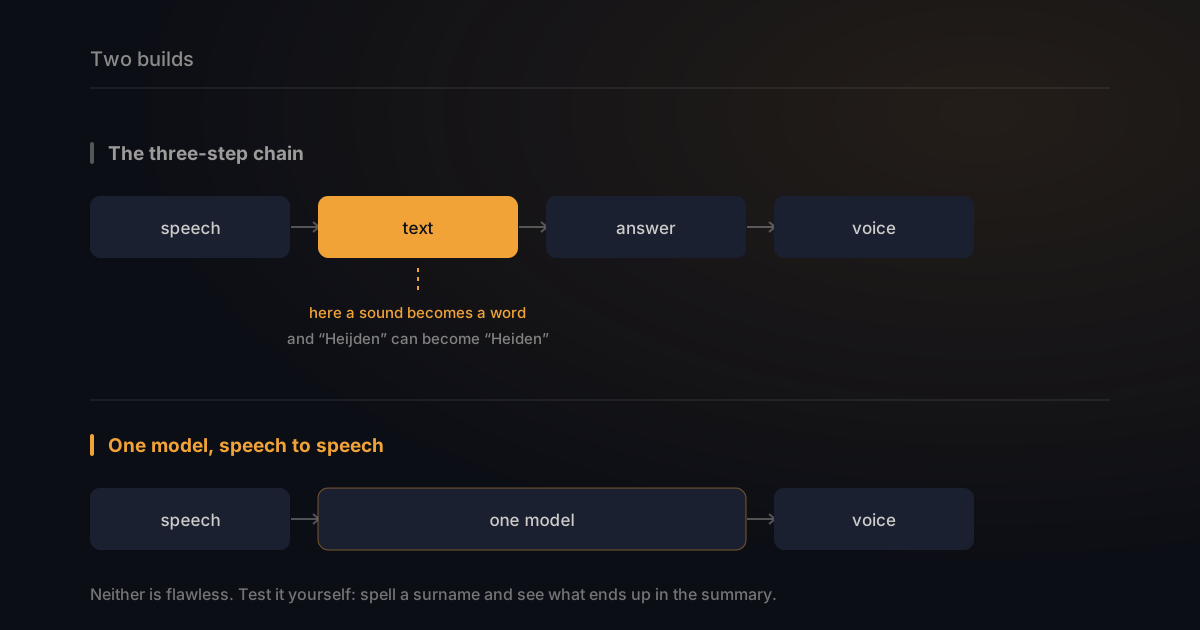
Why this is hard comes down to how it is built. Most AI phone agents turn speech into text first, let a language model answer that text, and turn the answer back into a voice. In that first step a sound is written down as a word, and “Heijden” quickly becomes “Heiden”. There is also a build where a single model goes straight from speech to speech, without that step in between.
⚠️ Do not expect a perfect score from any system here. This is still the hardest part of speech recognition, ours included. What you do want to know: does it notice when it is unsure, and does it check? A system that asks you to confirm is more useful than one that confidently writes down the wrong name.
Listen to the audio quality as well. Ordinary telephony squeezes sound into a narrow band, which makes an s and an f sound alike. Some systems use wideband audio (G.722), which keeps more of the sound.
What to ask before you sign
Beyond the test call there are four things you cannot hear on the phone at all. Ask the vendor these before you commit to anything.
Do I keep my own number?
Some systems hand you a new number you then have to distribute. That means your van, your stationery and your website all have to follow.
What does a long call cost?
Some vendors charge per minute or per call. One caller who takes their time can then get unexpectedly expensive. More on that in what an AI receptionist costs per month.
Where are my calls stored?
A phone call with a customer contains personal data. Ask which country it is kept in and whether it is used to train models.
Does it say it is AI?
Since 2 August 2026 the European AI Act requires that people know they are talking to an AI system. An AI receptionist that passes itself off as human is not clever, it is against the rules.
How BeepSweep does it
Sweep, the AI receptionist inside BeepSweep, can be tested on these five points without an appointment: you call it yourself and hear it.
The call engine goes from speech to speech in a single model, without a separate step into text and back. That is a difference in build, not a promise about the outcome: how it works out is something you should hear for yourself. Audio runs in G.722 wideband. Sweep says at the start of every call that it is an AI. For urgent calls it transfers live to your mobile, and on the Enterprise plan to the colleague who handles it.
Afterwards you get a message with a one-sentence summary, the details pulled out, the full transcript, the recording and a reply ready to send. It arrives on WhatsApp, SMS, email or in the app. You keep your own number, because it runs on call forwarding.
Turning missed calls into text is free for 15 messages a month, no credit card. Sweep itself starts at 6.99 euro a month, with no per-call charges. What Sweep will not do is negotiate, or agree a price you then have to honour.
If you first want to know what one of these actually is, read the explanation in plain language.
Frequently asked questions
How long does a test call take?
Allow ten minutes for all five. Do them in one call if you can, so you also hear how the system handles a conversation that goes in several directions.
Do I have to do this with every vendor?
Yes, in the same order with the same sentences. Otherwise you are comparing behaviour you provoked at different moments.
Can I have someone else do it?
Better not. You know which questions come in at your place and what a good answer would be. Someone who does not know that tests the general case.
What if the demo number works better than the real service?
Ask whether the demo runs on the same engine as the service you would buy. Then ask for a trial period on your own number.
How is this different from an answering service with people?
At an answering service a person picks up, usually at a price per call. The trade-off is set out in the difference between the two, and which shape fits you in the comparison of missed-call solutions.
In short
Five things in one test call: use your own questions, talk over it, ask something impossible, ask for the summary, and spell a surname.
Those five say more than a product page, because they provoke the behaviour your callers will provoke later. What you are left with is not a feeling but a comparison.