What is an AI receptionist? Explained in plain English.
An AI receptionist is the same kind of AI as ChatGPT, with an ear and a voice attached. How it works, what it can and can't do, and what to check.
You probably know ChatGPT: you type a question, an answer comes back. An AI receptionist is the same kind of software — it just has an ear and a voice attached. You don’t type, you talk. And the answer doesn’t appear on your screen, you hear it.
That program sits on a phone line. It can be your own mobile number, or a business line. If you don’t pick up, the program does.
So it isn’t a robot, and it isn’t a recording. Under the bonnet it’s the same kind of AI that ChatGPT runs on. What it doesn’t know is everything about the world — it knows what you’ve told it about your business.
It actually listens, it isn’t playing a recording
Every sentence in the conversation goes through the same loop: it hears what you say, works out a reply, and speaks it. The whole loop takes about a second. That’s why it feels like talking rather than waiting for a machine.
Which is exactly what separates it from a phone menu. A menu has fixed buttons and a fixed script: if your reason isn’t on the list, you can’t get through. An AI receptionist has no buttons. Someone can say “I’m calling about last month’s invoice, but actually about something else too” and still get a sensible response.
Connecting it is simpler than people expect. You set unanswered calls to forward to the service’s number. That happens at network level, with a short code or through your carrier — your number doesn’t change and you install nothing. How those codes work is covered in our piece on call forwarding codes.
Calls you answer yourself never reach the AI. It only steps in on the ones you let go.
The detour through text is where names get mangled
An AI receptionist can be built two ways, and you only notice the difference when someone spells out their surname. The common approach turns speech into text, lets the AI answer that, and turns the answer back into speech. Newer systems skip the middle step: one model that hears and speaks directly.
Why it matters: every conversion is a moment where something can be lost. A name the speech recognition writes down wrong stays wrong for the rest of the call — the AI only ever sees the text, not what was actually said. Same goes for a house number, a postcode or a phone number.
The second difference is pace. Fewer steps means less delay between your sentence and the reply. That hesitation is exactly what people hear when they realise they’re talking to a machine.
Then there’s sound quality. Phone lines have traditionally used a narrow band that squeezes the range of the voice; wideband audio lets more of it through. For ordinary conversation that barely matters — for making out individual letters and digits it does.
A concrete question to ask a provider: does it run through text, or straight from speech to speech? The answer tells you something else too: anyone who doesn’t know didn’t build it themselves.
What it can do depends on what you give it
An AI receptionist can do more or less depending on what you give it access to and how far the provider has built. Roughly speaking there are four layers, and each layer carries the ones below it. Where a provider stops is usually also where the price difference between plans sits.
- Answering and asking. It picks up, asks who’s calling and what about, and sends you the result as text. It answers nothing on your behalf. You don’t have to give it anything for this.
- Answering questions. You feed it information about your business: opening hours, what you do, what things cost, common questions. Often that gets pulled from your website automatically. From then on, callers don’t need a call back for something simple.
- Committing to something. Give it access to your calendar and it can book an appointment, take a reservation or set a callback slot. This is what these tools turn out to be genuinely good at, and it answers the question of whether an AI receptionist can make commitments: it can, if you hand it the key.
- Transferring. It passes the call to a human. That needs routing rules, and for a team, separate lines per person, so an urgent call still reaches someone.
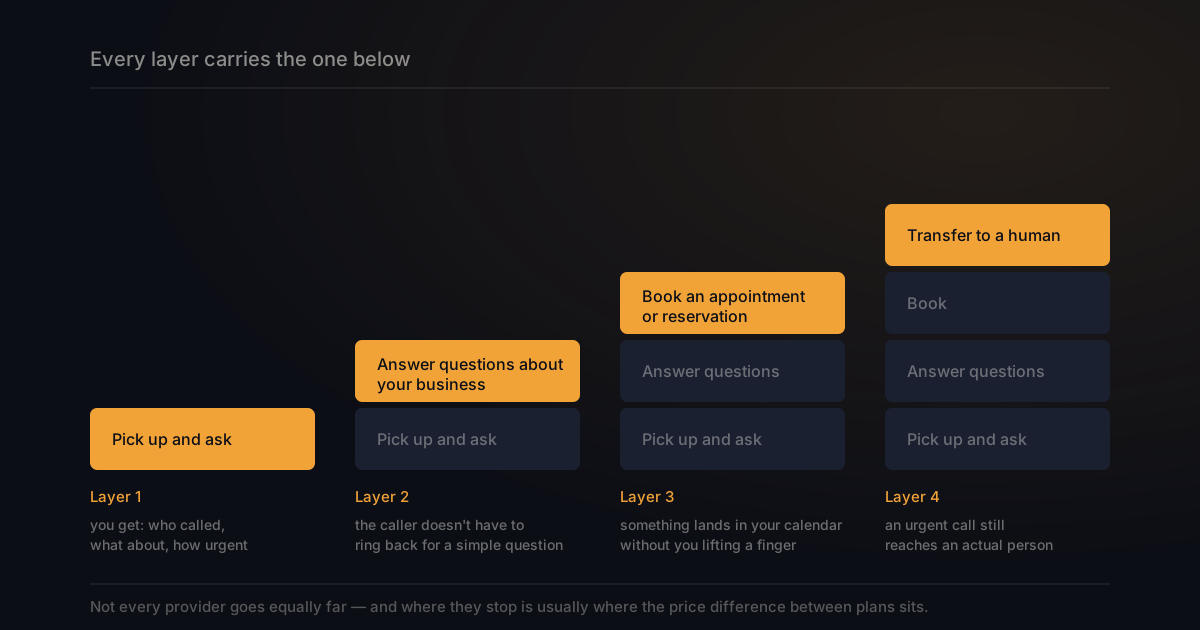
Providers differ a lot in how far they go. Some only deliver the first layer, others everything up to transferring. That’s also why prices for something with the same name run from a few tens of euros to several hundred a month.
How those layers play out at a company with equipment out in the field is covered in our piece for HVAC and plumbing. If you handle patient data, three further rules apply, set out in AI receptionist for medical practices.
Here’s what happens in twenty seconds
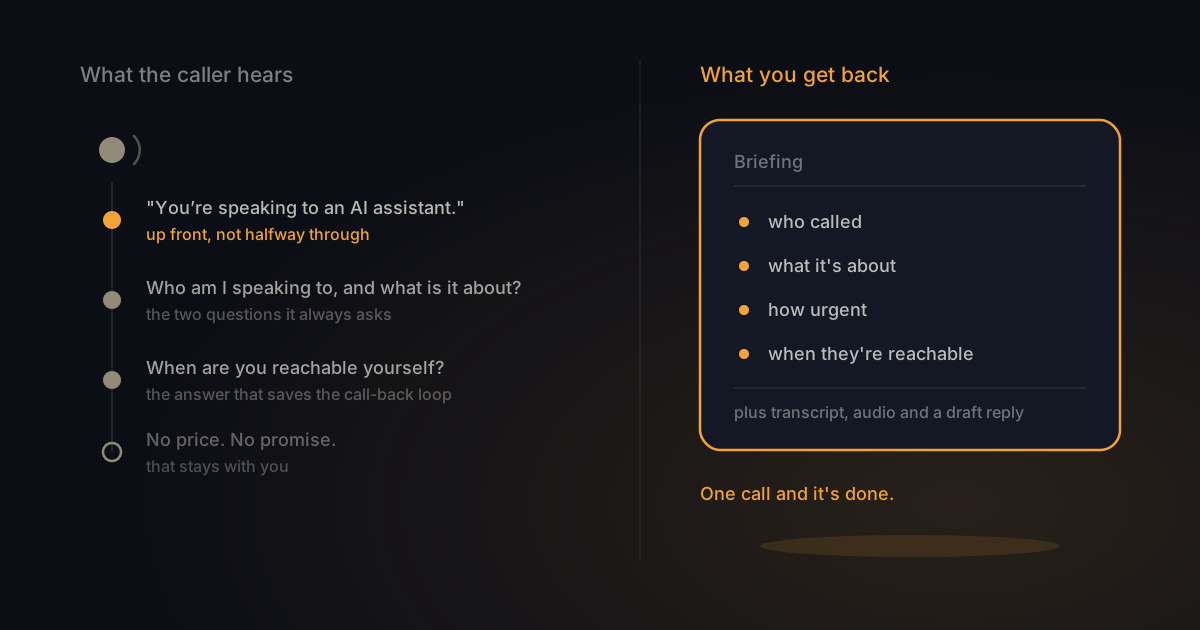
The caller hears a greeting and, straight after it, that they’re speaking to an AI. Then come the questions: who am I speaking to, and what is it about. Many services also ask when the caller is reachable themselves. Within half a minute the call is done and you have a message.
That last question looks like a detail and saves the most. Knowing when someone is free is the difference between calling back once and chasing them for two days.
What happens beyond that depends on the layers above. On the first layer it notes the question and doesn’t answer it. If it has your calendar, the call can end with an appointment already in the diary.
Voicemail records, this asks back
The difference with voicemail isn’t the technology, it’s the direction: voicemail lets the caller talk, an AI receptionist talks back. That changes what you’re left with after a missed call — not a request to ring someone, but the answer to why they rang in the first place.
- Voicemail — a name and a number. You call back, they don’t pick up, and the loop starts again.
- Voicemail to text — you read in ten seconds what it was about. Saves listening, but you still don’t know when you’ll catch them.
- AI receptionist — someone has asked. You know who, what about, how urgent, and often when they’re free.
A human answering service does that asking too, just at a per-call or per-minute rate rather than a flat fee. We’ve worked both through separately: an AI receptionist versus an answering service and versus a receptionist on payroll.
In the EU it has to identify itself since 2 August
Since 2 August 2026, article 50 of the European AI Act has applied. Anyone talking to an AI system has to be told so, unless it is obvious to a reasonably observant person. For an AI receptionist that means a notice at the start of the call. What you have to do with the recording and the transcript after that is covered in what the GDPR asks of you.
The regulation puts that duty on the provider of the system, not on the business using it. So if you buy such a service, this is mainly something to check: does it say so by itself, or do you have to switch that on?
There is a second requirement in there that gets less attention. The notice has to be “clear and distinguishable” and it has to come at the latest at the time of the first interaction. Halfway through the call is too late, and so is waiting until the caller asks. The same paragraph requires the notice to meet accessibility rules.
The same service can cost thirty euros or nine hundred
Providers charge in four ways: a flat monthly fee, a rate per minute, a rate per call, or a flat fee with a rate once you go over it. Which works out cheapest depends less on the provider than on your own call pattern — how often the phone rings, and how long those conversations run.
What each model means when the bill arrives:
- Flat monthly fee. Predictable: in January you know what December costs. Do check what’s in the bundle, because it’s usually a number of calls or minutes rather than “unlimited”.
- Per minute. Cheapest on paper, hardest to predict in practice. A caller who asks follow-ups, hesitates or thinks out loud costs you several times what a thirty-second call does. Suits low volumes and short calls.
- Per call. More predictable than per minute, because length stops mattering. Better value as soon as your calls run longer.
- Flat fee plus usage. A floor with a rate on top. The surprise here is almost always the rate above the bundle — ask about that, not about the entry price.
On top of that, some providers charge a one-off setup fee and others don’t.
The upshot is that there’s no single market price. What an AI receptionist costs per month is broken down in a separate piece.
Different needs call for different offers
So the question isn’t which provider is best, but which one fits your situation. If you get a handful of calls a week, an expensive layer with transferring is money thrown away. If you’re called all day with the same questions, a knowledge base pays for itself — and paying per minute works against you.
Roughly three situations:
- Few calls, short ones. Layer 1 is enough: pick up and ask. A low flat fee or per call. Anything above that is paying for what you don’t use.
- Regular calls with recurring questions. Layer 2 earns its keep, because every question the AI answers is a call you don’t have to return. Check what it costs to fill and maintain the knowledge base.
- High volume, urgent calls in the mix, or a team. Layers 3 and 4. This is where booking and transferring start to count, and where the amounts genuinely climb — often per person.
Then four things you check regardless of your situation:
- Does it say it’s an AI by itself, and immediately? Required in the EU since August. Call your own number and listen.
- Can someone still reach a human, and how? Not a legal requirement, but it is the difference between an urgent job getting through and one that doesn’t.
- Do I keep my own number? A service that hands you a new number costs you all the visibility you’ve built.
- What happens if I go over? See the rate above the bundle.
If several options are on your list, we put them side by side without the sales pitch in our comparison of missed-call solutions.
How BeepSweep does it
Our version is called BeepSweep. It picks up, says it’s an AI, asks for a name and reason, judges how urgent it sounds and sends you a briefing over WhatsApp or email — with the transcript, the recording and a draft reply ready to send. You keep your own number and forwarding takes about two minutes to switch on.
On the question above: BeepSweep runs straight from speech to speech, without the detour through text, and the line carries wideband audio.
The layers show up in the plans. Solo answers and asks the follow-up questions. Enterprise adds a knowledge base, filled from your own website, plus opening hours and routing rules. Enterprise gives every team member their own line and inbox, with warm transfer to the right colleague. Live transfer works, and so does booking appointments in your calendar.
Solo is €25 a month and Enterprise €99, with 200 calls and €15 per extra user. No per-call charges on any plan.
Frequently asked questions
Can the caller tell it isn’t human?
Yes, and that’s the point. Since 2 August 2026 an AI system in the EU has to identify itself at first contact.
Does it work outside office hours?
Yes. Software doesn’t keep working hours; it answers whenever the phone rings. Opening hours are something you configure, not something built in by default.
What happens if the caller asks something it doesn’t know?
On the first layer it notes the question and it lands in your overview. With a knowledge base it will try to answer — that’s the difference between layer one and two.
Can it put an appointment in my calendar?
Only if you give it access to that calendar and the provider offers that layer. Ask rather than assume.
Do I have to change my phone number?
No, as long as the service works through forwarding. You keep your own number — mobile or business — and set unanswered calls to pass through once.
Why does one AI receptionist get names right when another doesn’t?
Usually it comes down to how it’s built. If the call runs through speech recognition into text first, a misspelt name is locked in from that point — the AI only ever sees the text. Systems that go straight from speech to speech don’t have that step.
In short
- An AI receptionist is the same kind of AI as ChatGPT, with an ear and a voice attached, connected to your mobile or business line.
- It genuinely listens, and that loop takes about a second. Does it run through text or straight from speech to speech? That decides how well names and numbers survive — so ask.
- What it can do depends on what you give it. Four layers: answering and asking, answering questions, committing to something, transferring. Where a provider stops is where the price difference sits.
- In the EU, since 2 August 2026, it has to say it’s an AI at the latest at first contact. That duty sits with the provider, not with you.
- There are four ways of charging: flat monthly, per minute, per call, or flat plus usage. Which is good value depends on how often and how long people call — not on the provider.
Considering one? Read how to judge one for yourself before you sign anything.
Curious what’s left of a missed call? Switch BeepSweep on → You keep your own number, and missed calls arrive as readable text in WhatsApp. From €25 a month, with no per-call charges. Missed the call, not the message.